Knots of Consciousness
For the past few years I have been unusually drawn to the idea of boundaries. Whether I am walking through an exhibition or playing a game, it is the thing my attention keeps landing on.
Death Stranding describes the rope and the stick as humanity’s first tools, each of them able both to push away and to pull close. When I saw “The Line, the Borderline, and the Floating Boundary” at the Chiayi Art Museum, the ridgelines of mountains and the drifting Tropic of Cancer had themselves become part of the show. And in the ordinary hours of my own working days, I am forever using frameworks of one kind or another to keep some grip on things, while at the same time trying to break through the boundaries they draw.
Watching boundaries gather and come undone has quietly become part of daily life.
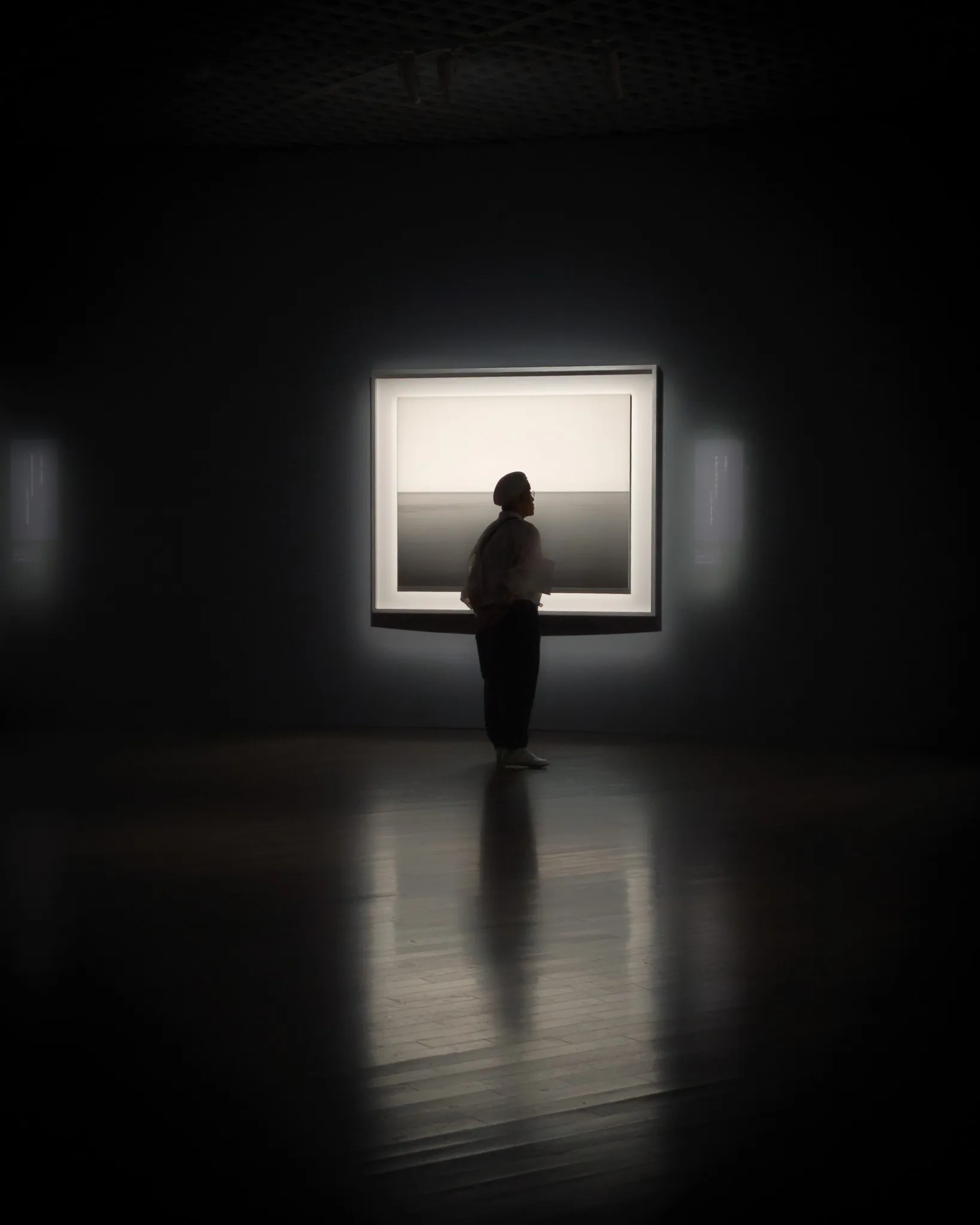
Recently I saw an exhibition of Hiroshi Sugimoto’s work, and came away with a clearer understanding of boundaries, or perhaps a blurrier one. In the Seascapes series, the clearest border of all seems to be the horizon, the line that divides the sea from the sky. But if you set sail toward it, everyone except Truman will discover that the boundary is endless.
And yet the horizon is the one thing that lets ancient people and modern people cross the gulf of time together. For thousands of years, everyone has been able to look at almost exactly the same view.
A few weeks after the exhibition, we boarded a train toward Sagami Bay again, heading for the Enoura Observatory, designed and built by Sugimoto.
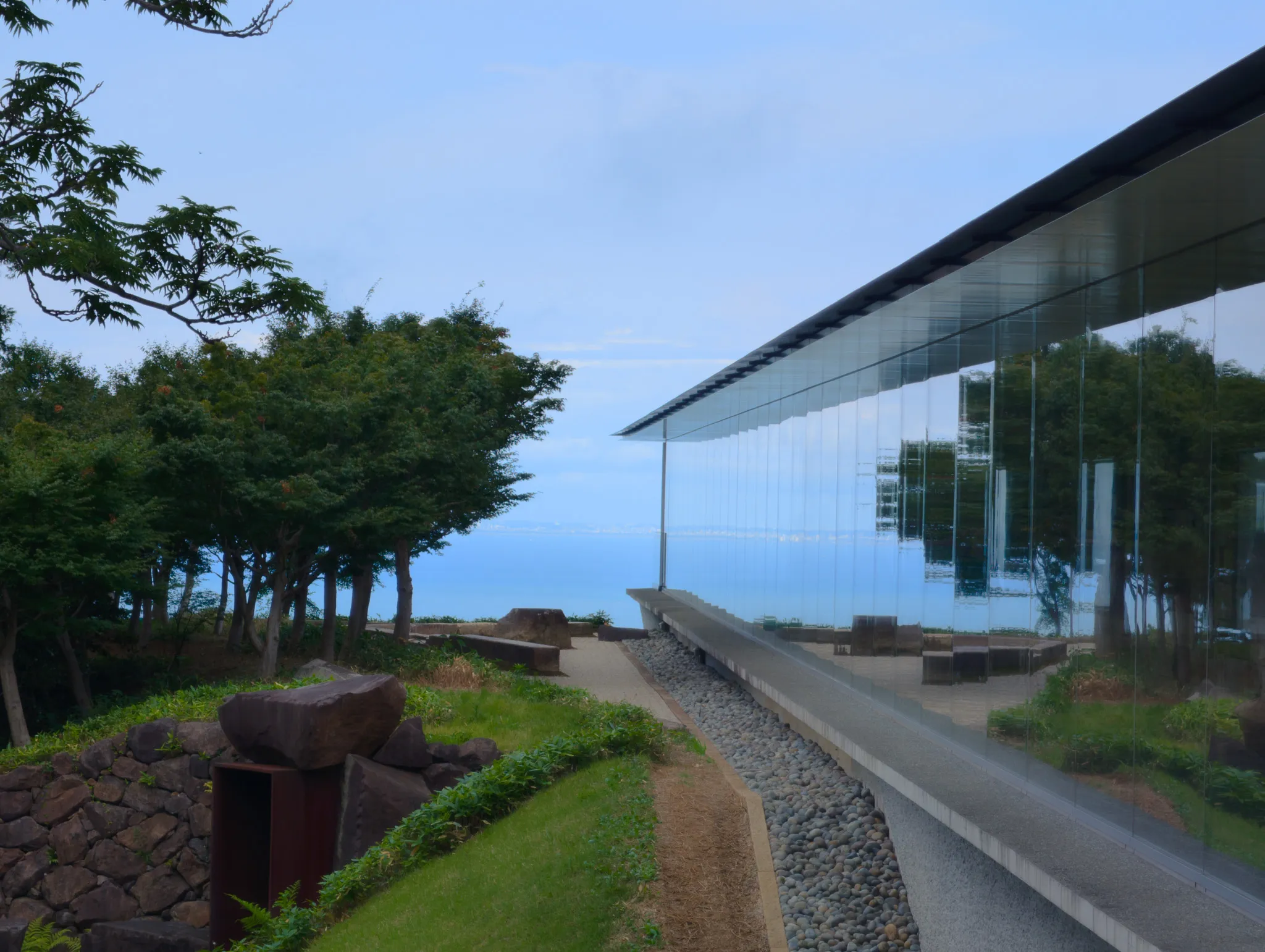
The visitor’s booklet opens like this (loosely translated from the Japanese):
Art has always stood at the frontier of human consciousness in every age, from cave paintings to the paintings made in the service of religion and royal power. Now art is gradually losing anything left to sing the praises of, and what remains within its reach is to return to the place where human consciousness first arose, and to chew over the origins of consciousness once more. The first thing ancient people did upon gaining consciousness was to confirm where they stood within the whole universe. That is where art begins. The winter solstice is the darkest day of the year, and from there the year turns back toward the summer solstice, and the sky is measured again. In that turning, a thin gap opens onto the future.
Beyond its instruments for measuring the sky, the Enoura Observatory gathers many objects that record turning points in history. The front gate of Meigetsu-in in Kamakura, half destroyed in the Great Kantō Earthquake and later restored. Paving stones from the tracks of Kyoto’s streetcars, taken up after the line was abandoned. A marble relief of the Tree of Life that once stood beside a Venetian canal.
The objects at the Enoura Observatory are like knots tied one after another along a hemp rope. The shape of each knot records the path along which a consciousness took form, as though the whole place were an exhibition curated on the scale of human history. The markers for the solstices and the equinoxes form a different set of axes, marking the cycle that returns year after year, opening a dimension distinct from the long river of history and its turning points.
Walking slowly through the wide grounds and looking closely at these objects feels like tying your own knot onto that rope measured in human lifetimes, using a fine needle and thread, shifting things by an amount too small for the eye to see.
Finishing my walk through the Enoura Observatory by Sagami Bay brought back the enormous impact I had felt from the curation of “The Line, the Borderline, and the Floating Boundary.” Seascapes, Theaters, the Enoura Observatory: I had only ever known them through video introductions, and I had never understood why Sugimoto carried so much weight. Retranslated and reinterpreted through a streaming platform, however much care the presenter poured into conveying the context, it never came close to what it feels like to stand in the exhibition itself, where concept and object draw together into one.
Only after sinking deep into the exhibition’s context did I begin to feel what he was reaching for. The gathering and the undoing of boundaries. The knots of consciousness. Seascapes that cross time and space. The axes of light and shadow that swing back and forth through the solar terms each year.
Sugimoto’s exhibitions always carry a certain worry about art forms withering away. But as the objects themselves show, whether it is the gate of Meigetsu-in or the paving stones of an abandoned tram line, everything moves toward decay and disappearance. And then these same things are restored, or shaped into something else, and become another story, and are given a new life.
From dynasties at the height of their glory to the stars themselves, everything eventually falls apart. But that vanishing is not the end. Just as in Ragnarök in Norse mythology, or in Shiva’s dance of destruction, when people tie a knot named “the end” onto a story, a few hundred years later someone always picks it up again and ties the next knot onto it.
— ,
Translated from the Traditional Chinese original.